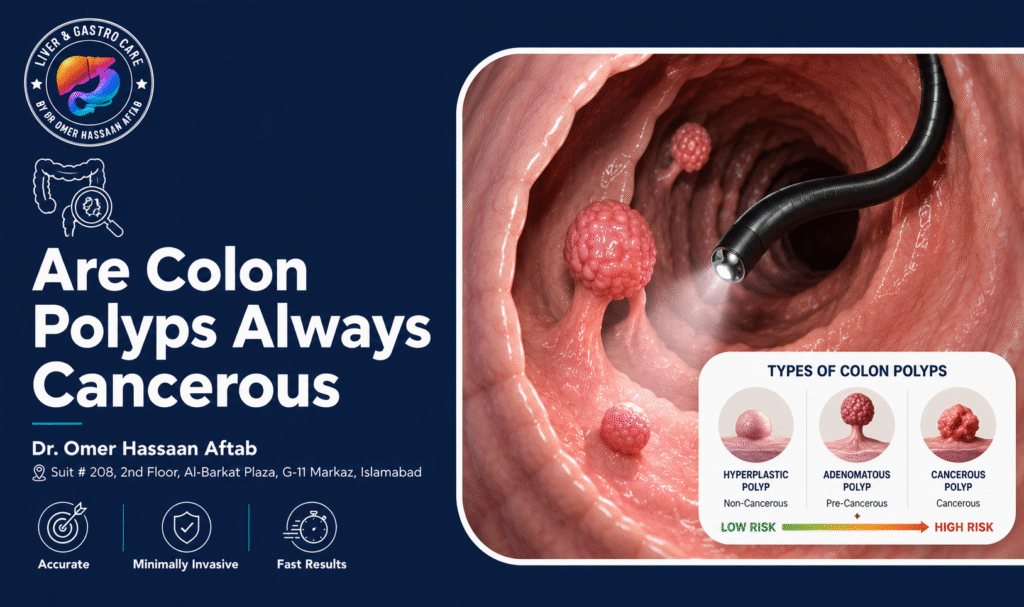
No, most colon polyps are not cancerous. However, certain types, adenomas and sessile serrated lesions, are pre-cancerous: given time, usually 7–10 years or more, a small fraction can turn into colon cancer. That is why polyps are removed during colonoscopy. The risk rises with polyp size (especially 1 cm or larger), number, villous features and high-grade dysplasia. Small hyperplastic polyps in the rectum carry very little risk.
Key points
- Most colorectal cancers start as polyps; removing polyps prevents cancer.
- Only a small percentage of adenomas become cancer.
- Polyps under 1 cm rarely contain cancer; larger ones carry more risk.
- Polyps usually cause no symptoms, so screening matters.
Table of Contents
- Types of Colon Polyps and Their Risk
- What Are the Odds of a Polyp Being Cancerous?
- How Fast Do Polyps Grow?
- Symptoms
- Who Is at Risk?
- Detection and Removal
- Preventing Polyps
- Frequently Asked Questions
Types of Colon Polyps and Their Risk
| Type | Cancer potential |
|---|---|
| Hyperplastic (small, rectum/sigmoid) | Very low |
| Inflammatory / pseudopolyps (in IBD) | Not pre-cancerous themselves |
| Tubular adenoma | Low; the most common pre-cancerous polyp |
| Tubulovillous / villous adenoma | Higher |
| Sessile serrated lesion / traditional serrated adenoma | Moderate; can progress faster |
What Are the Odds of a Polyp Being Cancerous?
Only a small proportion of adenomas ever become cancer. The chance that a polyp already contains cancer depends mainly on size: very low for polyps under 1 cm, and rising for polyps of 2 cm or more, especially with villous features or high-grade dysplasia. Your pathology report gives the specific answer for your polyps. Read what happens if a polyp is found.
How Fast Do Polyps Grow?
Most adenomas grow slowly, and the adenoma-to-cancer sequence is estimated to take around 7–10 years on average. Serrated lesions may progress more quickly in some cases. This long window is why colonoscopy every few years is so effective.
Symptoms
Most polyps cause no symptoms. Larger ones may cause:
- Blood in or on the stool, or black stool
- Iron-deficiency anaemia
- Change in bowel habit or mucus
- Rarely, abdominal pain
Bleeding is not always piles; see bawaseer ka ilaj and rectal bleeding.
Who Is at Risk?
- Age over 45
- Family history of colon cancer or polyps
- Inherited syndromes (FAP, Lynch syndrome)
- Inflammatory bowel disease
- Obesity, smoking, alcohol, diets high in red and processed meat and low in fibre
- Type 2 diabetes and sedentary lifestyle
Detection and Removal
Colonoscopy is the best test, because it finds and removes polyps in the same procedure (polypectomy). Stool tests (FIT) can screen for hidden blood, but a positive result needs colonoscopy. Follow-up intervals depend on the polyps found; see how often you need a colonoscopy.
Preventing Polyps
- Start screening at 45 (earlier with family history)
- Eat more fibre, vegetables, fruit and whole grains
- Limit red and processed meat
- Stay active and maintain a healthy weight
- Avoid smoking and alcohol
Dr. Omer Hassaan Aftab Ahmad performs screening colonoscopy and polyp removal at G-8 Markaz, Islamabad. See our colorectal cancer screening page.
Urdu Mein Khulasa
بڑی آنت کے زیادہ تر پولپ کینسر نہیں ہوتے، لیکن کچھ قسمیں جیسے ایڈینوما اور سیریٹڈ پولپ سات سے دس سال میں کینسر بن سکتی ہیں، اس لیے کولونوسکوپی میں انہیں نکال دیا جاتا ہے۔ بڑے، زیادہ تعداد والے اور بعض خاص قسم کے پولپ میں خطرہ زیادہ ہوتا ہے۔ عام طور پر پولپ کی کوئی علامت نہیں ہوتی، اس لیے پینتالیس سال کے بعد یا خاندان میں کینسر ہو تو کولونوسکوپی کروائیں۔
Frequently Asked Questions
What are the odds of a colon polyp being cancerous?
Low for small polyps. Risk increases with size over 1–2 cm, villous features and high-grade dysplasia.
How fast do colon polyps grow?
Usually slowly; adenomas typically take 7–10 years or longer to become cancer.
Should I be worried if polyps were found?
Usually not. Removing them is protective; follow the recommended surveillance schedule.
How can I prevent colon polyps?
Eat a high-fibre diet, limit red and processed meat, stay active, avoid smoking and alcohol, and get screened.
Can polyps be removed without surgery?
Yes. Almost all polyps are removed during colonoscopy; only very large or cancerous ones need surgery.
Conclusion
Colon polyps are common and mostly harmless, but some are the earliest stage of cancer. Finding and removing them is one of the most effective cancer-prevention steps available. For colonoscopy in Islamabad, consult Dr. Omer Hassaan Aftab Ahmad on 0336 5993116.


