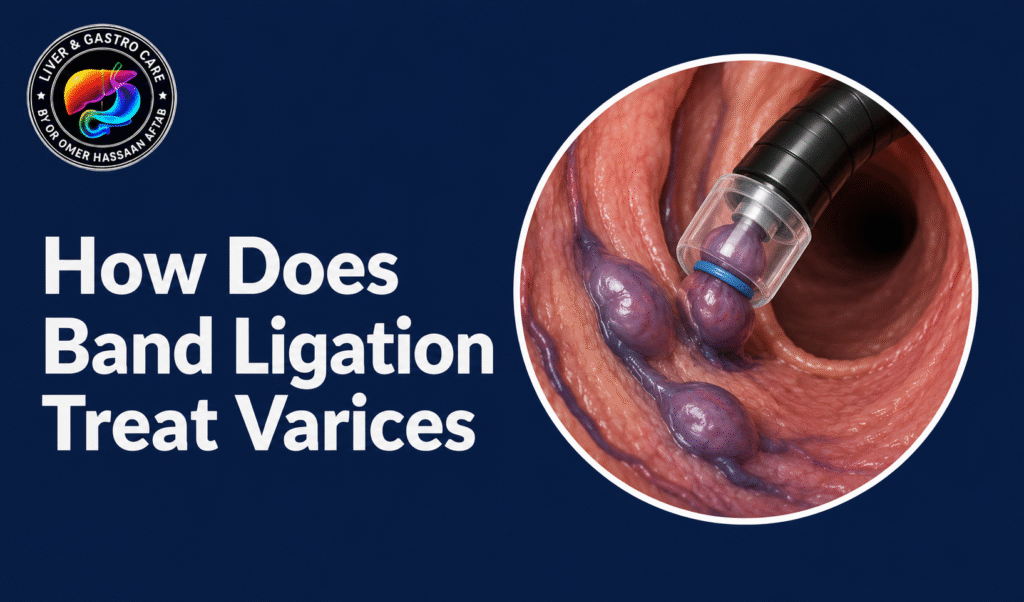
Endoscopic variceal band ligation (EVL) treats oesophageal varices, the swollen veins in the food pipe caused by portal hypertension in liver cirrhosis. During an endoscopy, small rubber bands are placed around the varices, cutting off their blood flow so they shrink, scar and disappear over a few weeks. Banding is used both to stop active bleeding and to prevent a first or repeat bleed. Several sessions, usually 2–4 weeks apart, are needed until the varices are eradicated, followed by regular check-ups.
Key points
- Banding is the first-line endoscopic treatment for oesophageal varices.
- It controls active bleeding in about 90% of cases.
- Most patients need 2–4 sessions to eradicate varices.
- Varices can return, so surveillance endoscopy continues afterwards.
Table of Contents
- What Are Varices?
- Who Needs Band Ligation?
- How Band Ligation Works
- Number of Sessions
- Recovery and Diet
- Side Effects and Risks
- Banding With Beta-Blockers
- Frequently Asked Questions
What Are Varices?
When cirrhosis raises pressure in the portal vein (portal hypertension), blood finds detours through thin-walled veins in the food pipe and stomach. These swollen veins can burst and cause life-threatening bleeding: vomiting blood or passing black stools.
Who Needs Band Ligation?
- Active variceal bleeding (emergency banding)
- Medium or large varices that have not yet bled (primary prevention), especially if beta-blockers are not suitable
- After any variceal bleed, to prevent recurrence (secondary prevention)
Everyone with cirrhosis should have a screening endoscopy; see liver cirrhosis in Urdu.
How Band Ligation Works
- You fast for 6–8 hours and receive sedation.
- An endoscope fitted with a banding device is passed into the food pipe.
- Each varix is suctioned into the cap and a band is released around its base.
- Several bands are placed in one session.
- Banded tissue dies off and falls away in 1–2 weeks, leaving scar tissue.
Number of Sessions
Sessions are repeated every 2–4 weeks until no varices remain (eradication), commonly after 2–4 sessions. Surveillance endoscopy follows at about 3–6 months, then every 6–12 months, because varices can return if portal pressure stays high.
Recovery and Diet
- Liquids for the first day, then soft food for 2–3 days
- Mild chest discomfort and pain on swallowing for 1–3 days
- Avoid very hot, spicy or hard foods for a few days
- Take acid-reducing medicine if prescribed to help ulcers from banding heal
- No driving on the day of sedation
Side Effects and Risks
- Chest pain and difficulty swallowing (temporary)
- Small ulcers where bands fall off, which can occasionally bleed
- Narrowing of the food pipe after many sessions (uncommon)
- Sedation-related risks
Seek urgent help for vomiting blood, black stools, severe chest pain or fever after banding.
Banding With Beta-Blockers
After a bleed, the best results come from combining banding with a non-selective beta-blocker (such as propranolol or carvedilol), which lowers portal pressure. Treating the cause of cirrhosis, such as hepatitis B or C or alcohol, further reduces risk. Read can cirrhosis be reversed.
Dr. Omer Hassaan Aftab Ahmad performs variceal band ligation at G-8 Markaz, Islamabad. See our band ligation page.
Urdu Mein Khulasa
جگر کے سکڑنے میں خوراک کی نالی کی رگیں پھول جاتی ہیں جنہیں ویریسز کہتے ہیں اور یہ پھٹ کر خون کی الٹی کر سکتی ہیں۔ اینڈوسکوپی کے ذریعے ان رگوں پر چھوٹے ربڑ بینڈ لگائے جاتے ہیں جس سے یہ سکڑ کر ختم ہو جاتی ہیں۔ عام طور پر دو سے چار سیشن لگتے ہیں۔ بعد میں ایک دو دن نرم غذا کھائیں۔ خون کی الٹی یا کالا پاخانہ ہو تو فوراً ہسپتال جائیں۔
Frequently Asked Questions
Do varices come back after banding?
They can, because the underlying portal hypertension remains. Regular surveillance endoscopy catches them early.
How long does it take for varices to heal after banding?
Banded tissue falls off in about 1–2 weeks; full eradication usually takes several sessions over 2–3 months.
What is the success rate of variceal banding?
Banding controls active bleeding in around 90% of cases and greatly reduces re-bleeding when combined with beta-blockers.
How many times can varices be banded?
As many times as needed; sessions are repeated until the varices are gone and whenever they recur.
Is band ligation painful?
It is done under sedation. Afterwards, mild chest discomfort and pain on swallowing for a few days are common.
Conclusion
Band ligation is a safe, effective way to prevent and stop variceal bleeding in liver disease. For screening endoscopy and banding in Islamabad, consult Dr. Omer Hassaan Aftab Ahmad on 0336 5993116.


