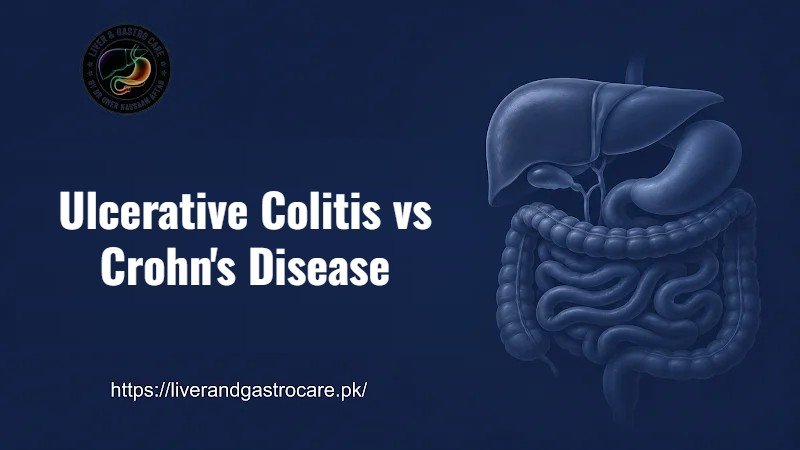
The main difference between ulcerative colitis and Crohn’s disease is where and how they inflame the gut. Ulcerative colitis (UC) affects only the large bowel (colon and rectum), starting in the rectum and spreading continuously upward, and inflames only the inner lining. Crohn’s disease can affect any part of the gut from mouth to anus, most often the end of the small intestine, in patchy “skip” areas, and inflames the full thickness of the bowel wall, which can cause strictures and fistulas. Both are forms of inflammatory bowel disease (IBD), diagnosed mainly by colonoscopy with biopsies.
Key points
- UC: colon only, continuous, lining only; bloody diarrhoea is typical.
- Crohn’s: anywhere, patchy, full thickness; pain, weight loss, fistulas.
- Smoking worsens Crohn’s; it does not protect enough to justify smoking in UC.
- IBD is different from IBS, which causes no inflammation or damage.
Table of Contents
- UC vs Crohn’s at a Glance
- Symptoms
- Complications
- How They Are Diagnosed
- Treatment
- IBD vs IBS
- Living With IBD
- Frequently Asked Questions
UC vs Crohn’s at a Glance
| Ulcerative colitis | Crohn’s disease | |
|---|---|---|
| Location | Colon and rectum only | Anywhere, mouth to anus (often terminal ileum) |
| Pattern | Continuous from the rectum | Patchy, with normal areas in between |
| Depth | Inner lining (mucosa) | Full thickness of the wall |
| Rectal bleeding | Very common | Less common |
| Fistulas, strictures | Rare | Common |
| Anal disease (abscess, fistula) | Uncommon | Common |
| Smoking | Not protective enough to recommend | Worsens disease |
| Surgery | Removing the colon can cure the bowel disease | Not curative; disease can recur |
Symptoms
Ulcerative colitis: bloody diarrhoea with mucus, urgency, feeling of incomplete emptying, lower abdominal cramps, tiredness.
Crohn’s disease: abdominal pain (often lower right), diarrhoea (may not be bloody), weight loss, fatigue, mouth ulcers, anal fissures or fistulas, poor growth in children.
Both: fever during flares, anaemia, joint pains, skin rashes and eye inflammation.
Complications
- UC: severe colitis, toxic megacolon, bleeding, higher colon cancer risk after many years
- Crohn’s: strictures with blockage, fistulas, abscesses, malnutrition
- Both: osteoporosis, blood clots, liver disease (PSC, more with UC)
How They Are Diagnosed
- Colonoscopy with biopsies: the key test; shows the pattern of inflammation
- Stool calprotectin to detect bowel inflammation
- Blood tests: anaemia, inflammation markers, nutrition
- MRI or CT enterography and capsule endoscopy for small bowel Crohn’s
- Stool tests to exclude infections, including TB, important in Pakistan
Treatment
- 5-ASA medicines (mesalazine): mainly for mild to moderate UC
- Steroids: short courses for flares, not long-term
- Immunomodulators: azathioprine, methotrexate
- Biologic and small-molecule therapies: for moderate to severe disease
- Surgery: colectomy for severe UC; resection of strictures or fistula surgery in Crohn’s
- Nutrition support, vitamin D, iron and calcium as needed
See our inflammatory bowel disease page for how we manage IBD.
IBD vs IBS
IBS causes pain and bowel changes without inflammation, bleeding or damage, and does not lead to cancer. IBD causes visible inflammation, can bleed and needs long-term medical treatment. See IBS symptoms.
Living With IBD
- Take maintenance medicines even when well
- Stop smoking (especially in Crohn’s)
- Get vaccinations and regular blood tests
- Surveillance colonoscopy after 8 years of colitis; see how often you need a colonoscopy
- Report flares early
Dr. Omer Hassaan Aftab Ahmad diagnoses and manages ulcerative colitis and Crohn’s disease at G-8 Markaz, Islamabad.
Urdu Mein Khulasa
السریٹو کولائٹس اور کرونز دونوں آنتوں کی سوزش کی بیماریاں ہیں۔ السریٹو کولائٹس صرف بڑی آنت کو متاثر کرتی ہے، مقعد سے شروع ہو کر اوپر تک مسلسل پھیلتی ہے اور اس میں خونی دست عام ہیں۔ کرونز منہ سے مقعد تک کہیں بھی ہو سکتی ہے، ٹکڑوں میں ہوتی ہے اور آنت کی پوری دیوار کو متاثر کرتی ہے، جس سے درد، وزن کم ہونا اور نالیاں بننا ہو سکتا ہے۔ کولونوسکوپی اور بائیوپسی سے تشخیص ہوتی ہے اور دواؤں سے بیماری کنٹرول کی جاتی ہے۔
Frequently Asked Questions
Is colitis more serious than Crohn’s?
Neither is simply “worse”. Crohn’s more often causes strictures and fistulas; severe UC can be dangerous during flares. Both are well controlled with modern treatment.
Does a colonoscopy show Crohn’s or ulcerative colitis?
Yes. Colonoscopy with biopsies is the main test to diagnose and distinguish them, sometimes with MRI or capsule endoscopy for Crohn’s.
What are 5 symptoms of Crohn’s disease?
Abdominal pain, diarrhoea, weight loss, fatigue and anal problems such as fissures or fistulas.
Can IBD be cured?
There is no medical cure, but long remissions are common with treatment. Removing the colon cures the bowel disease in UC.
What is the difference between IBS and IBD?
IBS is a functional disorder without inflammation; IBD (UC and Crohn’s) involves real inflammation and damage.
Conclusion
Ulcerative colitis and Crohn’s disease differ in location, depth and complications, and getting the right diagnosis guides the right treatment. For IBD care in Islamabad, consult Dr. Omer Hassaan Aftab Ahmad on 0336 5993116.