
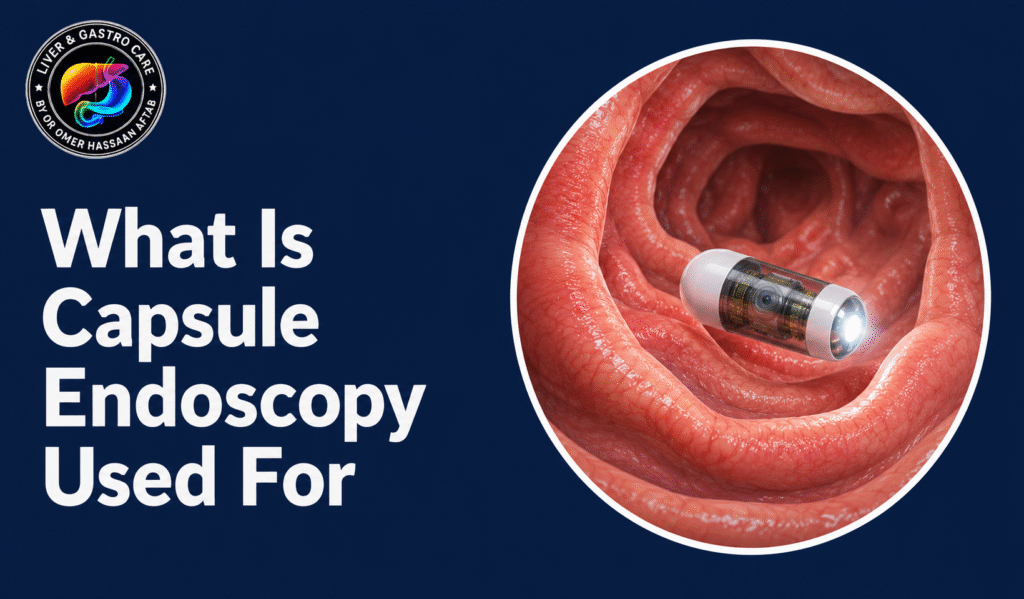
Capsule endoscopy is used to examine parts of the digestive tract, mainly the small intestine, that a standard upper endoscopy or colonoscopy cannot reach on its own. A patient swallows a small, pill sized camera that records thousands of images as it travels naturally through the esophagus, stomach, small bowel, and often into the colon, giving doctors a clear picture of areas that were previously difficult to visualize without surgery.
This procedure has become one of the most useful tools for finding the source of unexplained bleeding, tracking conditions such as Crohn’s disease, and investigating anemia that has no obvious cause. Because it requires no incisions and very little sedation, it has largely replaced older, more invasive methods for looking deep into the small bowel.
Table of Contents
- What Is Capsule Endoscopy
- How the Procedure Works
- Main Uses of Capsule Endoscopy
- Capsule Endoscopy vs Traditional Endoscopy
- Who Should Consider This Test
- Preparing for the Procedure
- What Happens After the Test
- Limitations and Risks
- Frequently Asked Questions
- Conclusion
What Is Capsule Endoscopy
Capsule endoscopy, sometimes called a pill camera study, uses a disposable capsule containing a tiny camera, light source, and wireless transmitter. Once swallowed, the capsule moves through the digestive tract on its own, taking several images every second and sending them to a recording device the patient wears on a belt. There is no tube, no wire, and in most cases, no sedation required, which makes the test far more comfortable than many people expect.
How the Procedure Works
The process itself is simple from the patient’s side, even though the technology behind it is advanced.
- The patient swallows the capsule with a glass of water.
- A small recorder worn on the waist captures images continuously.
- The patient goes about most normal daily activities during the recording period.
- After eight to twelve hours, the recorder is returned to the clinic.
- The gastroenterologist reviews tens of thousands of images to identify abnormalities.
- The capsule itself passes naturally in the stool and does not need to be retrieved.
Main Uses of Capsule Endoscopy
Doctors most commonly order this test to investigate problems located in the small bowel, an area that is long, twisted, and difficult to reach with a standard scope. Common reasons for requesting the study include:
- Unexplained or obscure gastrointestinal bleeding after normal upper and lower results
- Iron deficiency anemia with no clear source
- Suspected or confirmed Crohn’s disease and monitoring its activity
- Investigating unexplained abdominal pain or chronic diarrhea
- Screening for small bowel tumors or polyps in certain hereditary conditions
- Evaluating complicated celiac disease that is not responding to treatment
- Checking for arteriovenous malformations or other bleeding lesions
Capsule Endoscopy vs Traditional Endoscopy
Capsule endoscopy is not meant to replace a standard gastroscopy or colonoscopy, but rather to complement them when the small bowel needs closer evaluation.
| Feature | Capsule Endoscopy | Standard Endoscopy |
|---|---|---|
| Reach | Entire small bowel, part of the colon | Esophagus, stomach, and colon |
| Sedation | Usually not required | Sedation typically used |
| Biopsy capability | Not possible | Tissue samples can be taken |
| Comfort | Minimal discomfort, no tube | Mild throat or bowel discomfort |
| Best suited for | Obscure bleeding, small bowel disease | Ulcers, reflux, polyps, direct sampling |
Who Should Consider This Test
A gastroenterologist may recommend capsule endoscopy for patients who have already had a normal upper endoscopy and colonoscopy but still have unexplained symptoms. It is particularly useful for people with recurring, unexplained blood loss, chronic anemia that resists treatment, or a known inflammatory condition that needs regular monitoring of disease activity deeper in the small bowel. Patients who cannot safely undergo sedation for a traditional scope also benefit from this less invasive option.
Preparing for the Procedure
Preparation is usually simpler than for a colonoscopy but still matters for clear images.
- Follow a clear liquid diet the evening before the test, as instructed
- Avoid solid food for around twelve hours before swallowing the capsule
- Stop certain medications, such as iron supplements, if advised by the doctor
- Avoid strong magnetic fields, including MRI machines, until the capsule has passed
- Wear the provided recorder belt for the full recording window without removing it early
What Happens After the Test
Most patients return to normal eating a few hours after swallowing the capsule, once cleared by the clinic. There is no need to retrieve the capsule, since it passes naturally during a bowel movement within one to two days for most people. Results are not available immediately, as the recorded images must be reviewed carefully, which can take the gastroenterologist a day or more depending on the length of the recording.
Limitations and Risks
While generally very safe, this test does have a few limitations worth knowing before the procedure. The capsule cannot take tissue samples, so any abnormal finding that needs a biopsy will require a follow up procedure. There is also a small risk of the capsule becoming stuck if a narrowing or stricture already exists in the bowel, which is why patients with known strictures are usually evaluated first with imaging or a dissolvable patency capsule.
Frequently Asked Questions
What is capsule endoscopy mainly used to diagnose?
It is mainly used to find the source of bleeding in the small bowel that other tests could not detect, along with monitoring conditions such as Crohn’s disease, investigating unexplained anemia, and screening for small bowel tumors in certain higher risk patients. Because the small intestine is difficult to reach with a standard scope, this test fills an important diagnostic gap.
Is capsule endoscopy painful or uncomfortable?
No, most patients describe it as painless since the capsule is swallowed just like a large vitamin and no sedation or tube insertion is typically needed. Some people feel a brief sensation while swallowing it, but there is no discomfort once the capsule begins moving through the digestive tract.
How long does it take to get capsule endoscopy results?
Recording usually lasts between eight and twelve hours, and reviewing the tens of thousands of captured images can take the gastroenterologist an additional day or two. The doctor will then schedule a follow up visit to discuss the findings and any next steps.
Can capsule endoscopy replace a colonoscopy?
Not entirely, since a colonoscopy allows the doctor to take biopsies and remove polyps directly, which the capsule cannot do. It is generally used alongside or after a colonoscopy when the small bowel specifically needs to be examined, rather than as a full replacement.
What happens if the capsule does not pass naturally?
In rare cases, the capsule can become retained if there is an unknown narrowing in the bowel, and this may require removal through a follow up procedure. Doctors typically screen for this risk beforehand in patients with a history of bowel strictures or prior abdominal surgery.
When should someone consult a gastroenterologist about capsule endoscopy?
Anyone with ongoing unexplained bleeding, persistent iron deficiency anemia, or a digestive condition that needs deeper small bowel evaluation should discuss this option with a gastroenterologist in Islamabad. A proper history and prior test results help the doctor decide if this is the right next step.
Conclusion
Capsule endoscopy has changed how doctors investigate the small bowel, offering a way to see deep inside the digestive tract without surgery, sedation, or the discomfort associated with older techniques. From tracking down the source of obscure bleeding to monitoring Crohn’s disease and unexplained anemia, this test fills a diagnostic gap that a standard upper or lower scope simply cannot reach. It works best as part of a broader evaluation, often following a gastroscopy or colonoscopy that has already ruled out more common causes higher or lower in the digestive tract. For patients dealing with ongoing GI bleeding, a suspected case of inflammatory bowel disease, or complicated celiac disease, this procedure can provide answers that other tests have missed. If symptoms such as unexplained anemia or chronic diarrhea persist despite normal results elsewhere, it is worth discussing whether capsule endoscopy is the right next step with your doctor, since early evaluation often leads to a faster and more accurate diagnosis.